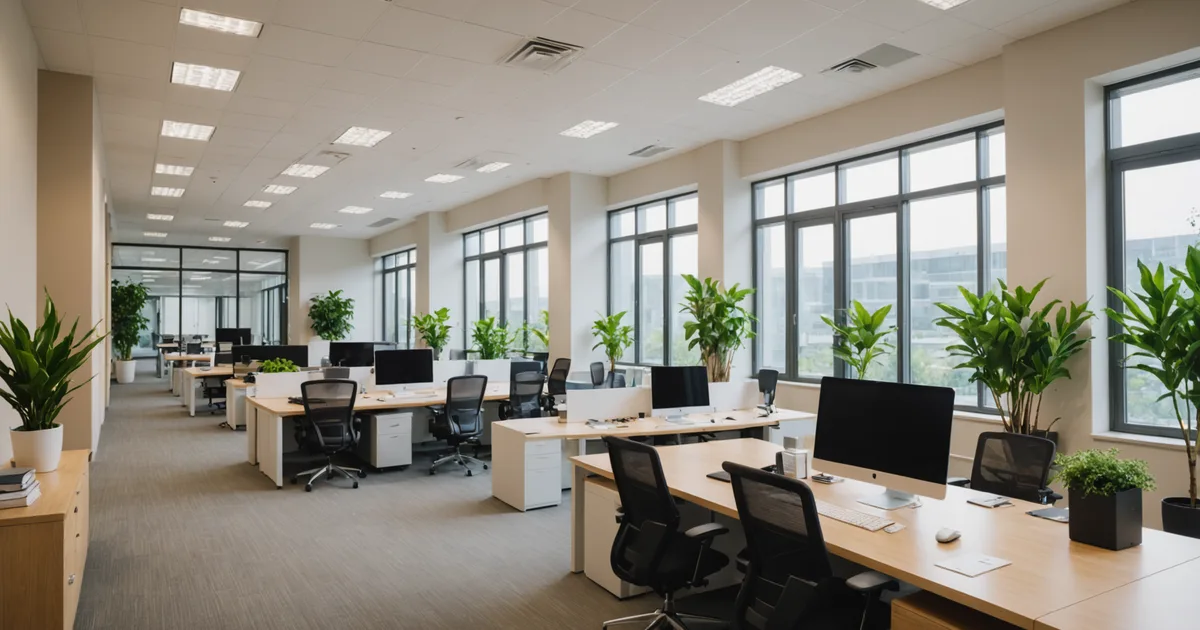
The most common objection we hear from facility managers considering an energy optimization system goes something like: "The last time we adjusted the HVAC schedule, we got a dozen complaints from the 14th floor by 10 AM." That experience is real and the concern is legitimate. Energy optimization done badly absolutely does compromise comfort. But the conclusion facility managers usually draw from that experience — that energy savings and occupant comfort are in fundamental tension — is wrong, and it leads to a risk-averse status quo that leaves substantial savings permanently unrealized.
What actually happened on the 14th floor is almost always a version of the same thing: someone made a coarse setpoint change or schedule adjustment without a good model of how the building's thermal systems would respond, comfort degraded, and the experiment was abandoned. The failure was in the execution, not in the concept.
Where the Tradeoff Myth Comes From
The comfort-vs-savings framing has a simple origin: the cheapest and most common forms of building energy optimization really do involve discomfort. Raising a cooling setpoint from 72°F to 76°F saves energy and makes people hot. Delaying morning pre-conditioning until an hour before occupancy instead of two hours before occupancy saves energy and leaves the space uncomfortable for the first hour of the workday. These are real tradeoffs, and they're the ones most frequently implemented by facilities teams under pressure to hit cost targets quickly.
The problem is that these approaches treat the building as if it has no thermal history and no predictable future. You're adjusting the operating point without any model of how the building responds, so you're essentially doing manual experiments on your occupants' comfort. Some of those experiments fail, some don't, but none of them are building on a principled understanding of the facility's thermal dynamics.
Predictive optimization is categorically different from this. When you know the load profile 24–48 hours ahead, you're not making comfort tradeoffs — you're restructuring when and how you consume energy so that the same comfort setpoints are maintained throughout occupied periods, but the energy used to achieve those setpoints comes disproportionately from cheaper, lower-demand time windows.
The Thermal Mass Principle: Saving Energy Without Touching Setpoints
The clearest illustration of no-tradeoff optimization is thermal mass pre-conditioning. A commercial building has substantial thermal mass — the concrete slab, partition walls, furniture, and HVAC equipment itself all store thermal energy. You can "charge" that thermal mass by cooling the space below setpoint during off-peak hours (when rates are cheap and occupants are absent), then coast through peak demand hours while the stored cooling capacity gradually depletes.
Done correctly, the occupied period setpoint never changes. Occupants arrive to a 72°F space and it stays 72°F all day. The energy consumption pattern is very different — more consumption during off-peak hours, less during peak hours — but the occupant experience is identical or better than an unoptimized building, because the HVAC system isn't fighting peak-hour outdoor conditions all day.
This approach does require an accurate forecast. You need to know how hot it's going to get, for how long, and how your specific building's thermal mass will respond to the pre-conditioning load, in order to calibrate the pre-conditioning depth correctly. If you overcool overnight and the forecast was wrong, you might have a cold building in the morning — an unusual complaint, but a real one. If you undercool overnight, you lose the benefit. The forecast is load-bearing in a way it isn't for cruder optimization approaches.
Industrial Throughput: A Different Version of the Same Myth
In industrial settings, the comfort analog is throughput. The concern is: if we optimize energy by shifting or reducing load, will production rates suffer? This fear is even more deeply entrenched than comfort concerns in commercial buildings, because the consequences of production disruption are more immediately quantifiable and more directly tied to revenue.
The throughput-vs-energy tradeoff is real in some specific cases. If you're running a process that requires continuous power for temperature uniformity — a chemical synthesis reactor, a heat treatment furnace, a data center with no thermal storage — your optimization latitude is narrow. Interrupting or shifting that load has direct production consequences. We're not going to pretend otherwise.
But the majority of industrial facilities have large amounts of what engineers call "flexible load" — energy consumption that can be shifted or curtailed within defined windows without affecting production schedules. Compressed air systems with large receiver tanks can absorb a 30-minute compressor curtailment without any downstream effect if the tank is full. Refrigeration systems in cold storage facilities have thermal mass that allows demand cycling. Water treatment systems often have significant buffering capacity. Lighting in areas not in active production is obviously flexible.
In practice, the facility managers with the strongest resistance to energy optimization programs are often the ones managing facilities where the most shiftable load exists. The resistance is based on an intuition — "any change to what we're running risks disrupting production" — that doesn't hold up when you model the specific systems rather than the general category of "industrial load."
What the Complaint Data Actually Shows
One thing we do consistently when deploying Voltpathio is track comfort complaints during the optimization period and compare them to the baseline period. The pattern we see is not zero complaints — that would be surprising given normal building variability — but complaints that are no higher during optimization periods than during baseline, and sometimes lower.
Why lower? Because predictive scheduling often results in better pre-conditioning than the prior static schedule. A building running on a schedule that was set years ago by a facilities manager who has since left, never updated for building improvements or occupancy changes, and applied uniformly regardless of weather conditions, is not operating optimally for comfort either. When we replace that with a weather-responsive schedule that explicitly models the morning warm-up or cool-down curve, the building often reaches setpoint more reliably and maintains it more consistently.
We're not claiming the comfort objection is always wrong. There are genuinely difficult scenarios: buildings with aging equipment that can't follow complex schedules, facilities with very heterogeneous thermal zones where optimization in one zone creates problems in an adjacent one, and situations where the building model hasn't been calibrated long enough to produce reliable recommendations. In those cases, running conservatively is the right call until the model quality improves. But those are implementation challenges, not evidence of a fundamental comfort-savings tradeoff.
The Practical Implication for Facility Managers
If you've had a bad experience with an energy optimization project that compromised comfort, the relevant question is not "was it the optimization or the comfort target that failed?" — it's "did the optimization system have an accurate model of how your building responds to schedule changes, and was the forecast input good enough to support the decisions being made?"
Bad comfort outcomes from energy optimization programs almost always trace back to one of three causes: inadequate building calibration data, static rule-based optimization without a forecast layer, or aggressive setpoint changes in a building that wasn't analyzed for thermal response time. These are solvable problems, not inherent constraints of the optimization category.
The frame we'd suggest instead: energy optimization and occupant comfort are competing goals only at the most primitive level of optimization — the level where you're adjusting setpoints manually without data. At the level of predictive schedule optimization with a calibrated building model, they're aligned goals. A well-conditioned, properly scheduled building that reaches setpoint reliably and maintains it throughout the occupied period uses less energy than one running on a fixed timer schedule fighting peak-hour conditions. The occupants are more comfortable and the bill is lower. That's the outcome we design for.